Enoch Hui’s Interior Worlds

Why a trained architect turned to interior design to fulfill his creative impulse 

Zolima CityMag2026.03.02

Enoch Hui is sipping a coffee inside the luminous atrium of Lee Garden Two, finishing some work on his tablet. His choice of location is no accident.  


“We designed this,” he says, gesturing to the nearby counter run by n.o.t. Specialty Coffee, with its fluted wood surface. “You can see that pattern, and also the cantilevered bar, the round tables — previously, they were at other space inside the building, but because of a renovation they had to move here, to the atrium. It’s all reused from the previous location, but being here gives it an interesting new context. The curve of the wood almost mirrors the columns here.”  


Hui is nothing if not an adaptable designer; in fact, it’s his defining ethos. “Personally, I don’t believe in any design styles or design trends,” he says. “What I believe is, design is fundamentally about problem solving and customisation.” 


You can see it in the projects that he has completed with his studio, Atelier E, which he founded in 2009. At Matsubishi, a Japanese restaurant in the Hong Kong Convention and Exhibition Centre, Hui designed an interior inspired by red Japanese torii gates. It looks nothing like the interiors he designed for the Tai Po branch of local coffee chain Coco Espresso — those ones are meant to evoke the “sea breeze in Santorini,” with terrazzo floors, rustic curves and whitewashed walls that are a not-so-subtle reference to the Greek islands.  


All of this stems from the design philosophy that Hui long ago developed to anchor his practice. “We call it RARE,” he says. “It stands for redefinition, adaptation, representation and elimination.” In essence, each project needs to stand out and reflect its unique context while also responding to constraints — which means Hui and his team aren’t afraid to trim any elements they find unnecessary.  


It’s a flexible framework that emerged from Hui’s early experience of working in Hong Kong after he returned in 2002 from studying architecture at the University of Bath. “When I came back, I worked for some architectural firms,” he says. “But in Hong Kong, we don’t have many really exciting buildings to work on.”  


Strict building regulations and high land prices mean “developers are just trying to fill up every available space,” he adds. “It’s hard to play around with interesting ideas. So after a few years I moved to a smaller firm that did interior design. And I started to love it because we don’t have any limitations.” 


Organic creativity 


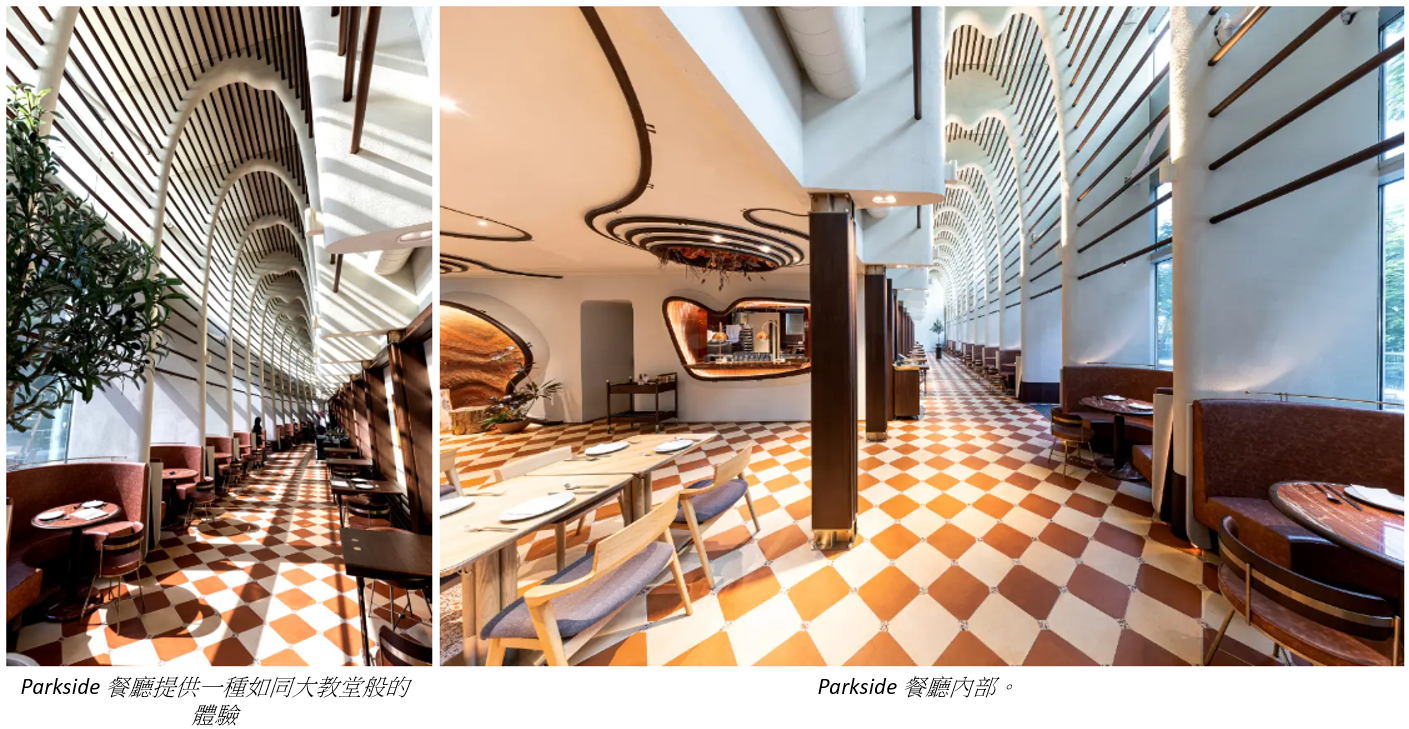
One of those creative opportunities came to light in 2024, when Hui began to work on the interiors for PARKSIDE, a restaurant inside the Nina Hotel in Tsuen Wan.  


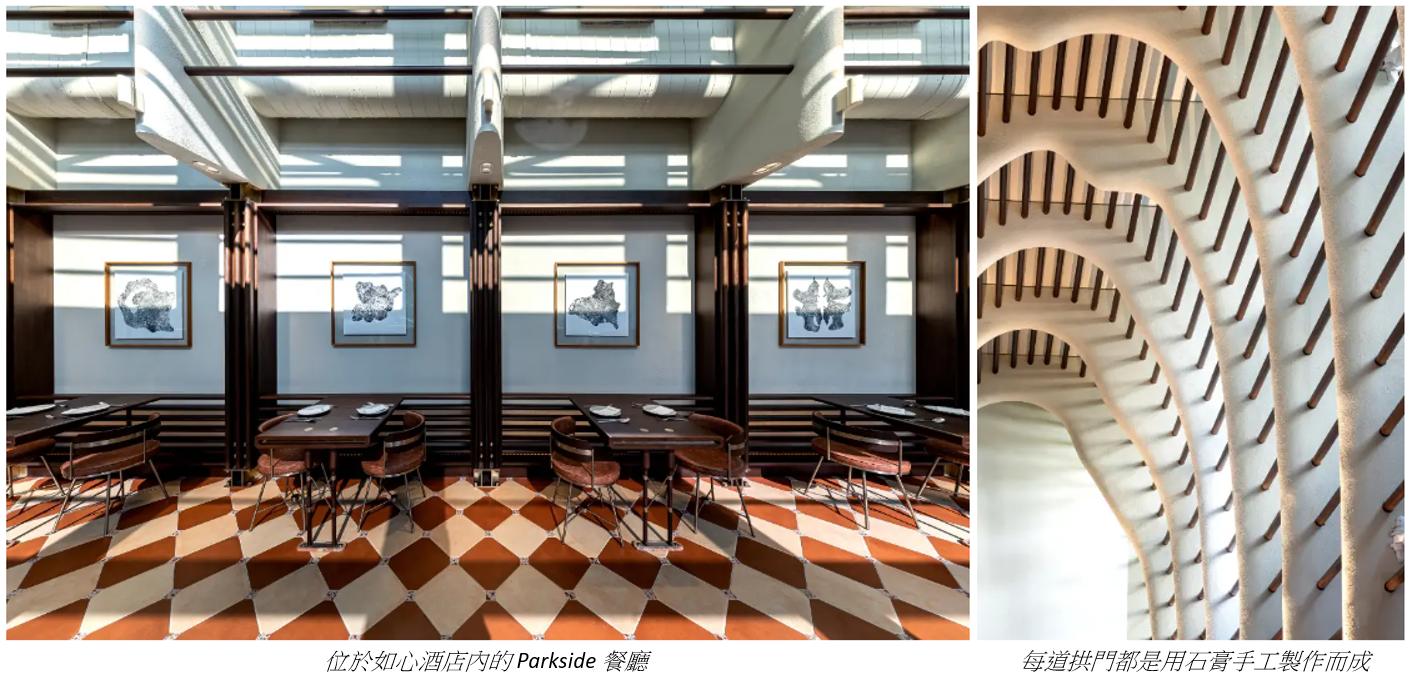
“It’s a space with really high ceilings, which is rare to find in Hong Kong,” he says. “There are a series of steel trusses. So we wrapped all the trusses to create this kind of cathedral-like atmosphere.” What had originally been a glass-and-steel space typical of any office tower is now defined by arches — each hand-formed with plaster to give them an organic feel — linked by thousands of horizontal wood rods that filter the afternoon sun.  


The overall effect is sleek yet rustic, a bit like the Greek-inspired interiors of Coco Espresso. Hui says he was inspired by the texture of the wood fossils housed inside the adjacent Nina Park, which was developed by Chinachem Group to showcase some of the fossils collected over the lifetime of its founder Nina Wang.  


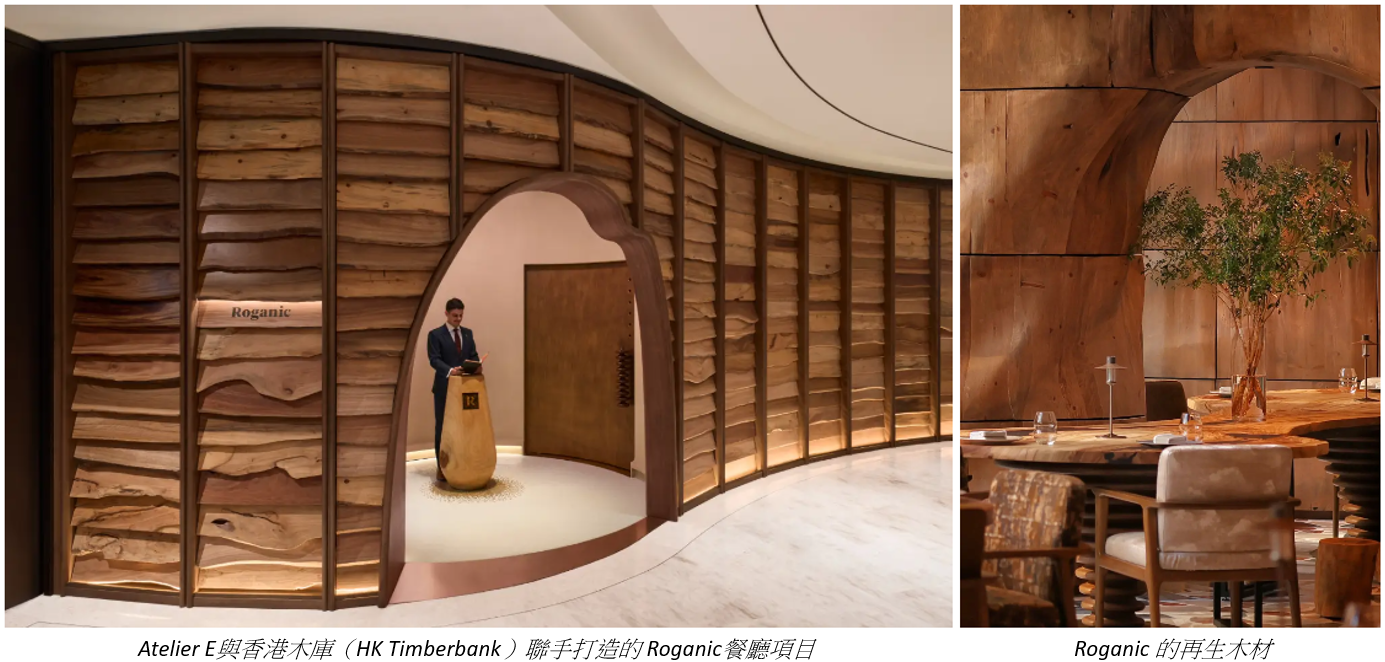
When he learned that a number of trees had been chopped down for the development of the fossil exhibition hall, and the wood had been collected by HK Timberbank — a non-profit organisation that salvages timber from locally-felled trees — Hui got in touch with founder Ricci Wong to create something for the Nina Hotel’s restaurant. 


“I’ve known Ricci for more than 10 years — he’s also an architect,” says Hui. Ricci ended up turning the reclaimed wood from Nina Park into a long feature wall that helps add warmth to a lower-ceilinged portion of the hotel restaurant.  


Local ingredients, local wood 


That turned out to be the start of a much larger collaboration. When Hui was contacted by chef Simon Rogan to design a new dining room for his Michelin-starred restaurant Roganic, he immediately thought of Timberbank. “I was impressed by Simon’s sustainable principles, his farm-to-table, zero-waste concept,” says Hui. He wanted to translate that into the restaurant’s physical space, so he invited Rogan to join him on a visit to Timberbank’s warehouse in Yuen Long.  


“Our first aim was maybe to create some tables with the wood,” says Hui. “But after visiting I was like, ‘Hey, let’s think bigger. Let’s use as much wood as we can. Maybe we can build the entire restaurant from this reclaimed wood.’”  


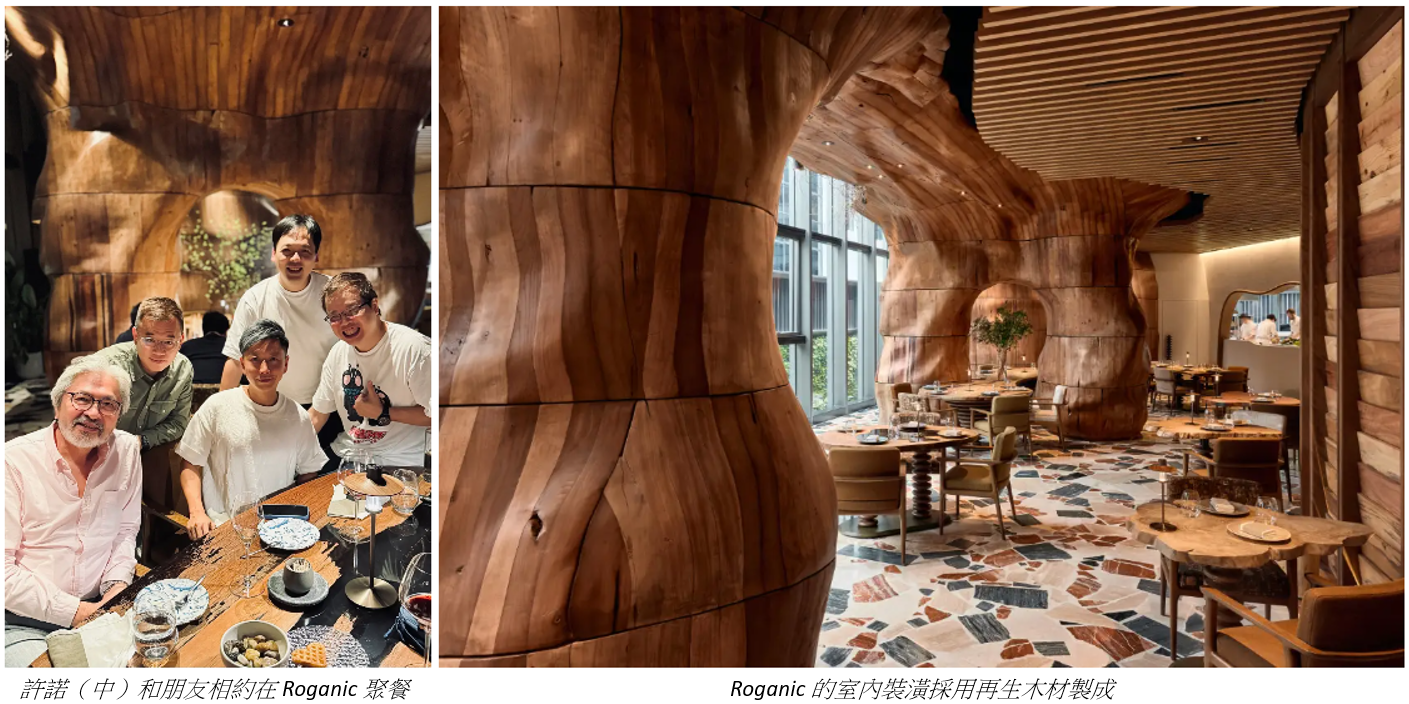
That’s essentially what they did. Guests arriving for dinner at the restaurant, whose revamped space opened last year, are greeted by a façade of wood louvres made from typhoon-damaged trees. They are seated at tables sliced from the trunks of enormous local trees like camphors, live edges retained to highlight the natural form and grain of the wood. And what they see when they look around is a remarkable cavern-like space made from undulating panels of reclaimed wood mounted on the walls and three structural columns that stand in the centre of the restaurant. 


“We built 3D models to make sure it would work,” says Hui. “Then Timberbank combined all these different species of wood into one solid cube, then they put it in the CNC machine and cut it by computer. We built it one-to-one in the factory, then took all the pieces and assembled it on site. It was very challenging.” 


Other elements affirm the restaurant’s sustainable bona fides, including stone flooring made of fragments left over from Hui’s other projects and a wine bar made from plaster made from discarded oyster shells. “They’re the oysters served at the restaurant,” notes Hui. 


Looking beyond Hong Kong 


Over the past few years, Atelier E has expanded its scope to Japan, where Hui and his designers are working on a number of projects for Hong Kong investors. These include three holiday houses in the ski resort of Niseko, completed in 2018, and two upcoming projects: a six-storey boutique hotel in Tokyo and an onsen resort in Hakone.  


These Japanese projects mark the studio’s first foray into architecture. Hui says he was surprised to learn how much easier it was to design buildings in Japan, where building codes are less prescriptive than in Hong Kong and there is less of a need to maximise every square inch of space for profit. “There’s more freedom for you when you build anything in Japan,” says Hui.  


At least there are still interiors to be done in Hong Kong. “That’s where you get to be really creative,” says Hui. “It all comes through in the interiors.” 


Hui spoke at the Business of Design Week Summit on December 4, 2025. In his keynote, “Design Beyond Styles & Rules”, he emphasised curiosity as the starting point of his design process, questioning everyday assumptions and revealing how design often defaults to convention without reflection. He also critiqued the industry’s obsession with styles and trends, and insisted it must be customised, functional, and grounded in problemsolving, responding to clients’ needs rather than designers’ personal preferences.  


To view Enoch Hui’s keynote at BODW 2025, please visit here 


Writer: Christopher DeWolf   


This column is produced in partnership with Zolima CityMag, an online magazine that explores Hong Kong’s arts, design, history and culture.    


   A black and grey logo

AI-generated content may be incorrect.